Our Technology

This page outlines the technology that lets AI specialized in the regulatory work of healthcare and long-term care run with high accuracy on minimal computation, and the thinking behind it.

How It Works

Architecture

We develop, provide, and operate three products in-house: SHISHI, CAIVA, and KAKKAI. SHISHI is offered as a series for multiple types of providers.

Kurashi Tech Platform — provided and operated as one

  • 03

    SHISHI

    AI agents that do the work

    Takes on real work as a specialist in regulatory operations.

  • 02

    CAIVA Opens in a new tab

    The company's knowledge vault

    Stores knowledge partitioned by role and gives the AI only what it needs.

  • 01

    KAKKAI

    The single gateway to AI

    Protects, logs, and reroutes all exchanges with external AI in one place.

AI does the work; people check and decide. It is an AI-native system, built around AI from the start.

Our Core Technologies

Core Technology

  • 01

    CAIVA: a knowledge platform that turns expert judgment into data

    We have in-house experts who can interpret regulations and make add-on decisions, and we accumulate their judgments as data. Manuals, past records, and the judgments of veteran staff are stored separately by access permission, and only the parts needed for an answer are passed to the AI.

    Benefits

    • High accuracy with minimal computation
    • No data entry or feedback needed from customers
  • 02

    KAKKAI: the single gateway to external AI

    All AI usage, whether OpenAI, Anthropic, our own models, or others, is consolidated into a single gateway, and every exchange is logged. If a particular AI suffers an outage or congestion, it automatically switches to another AI, and budgets are allocated in advance by department and task.

    Benefits

    • No data left outside
    • Keeps running through outages
  • 03

    Difference-only updates for regulatory revisions

    Regulated industries shift every year with reimbursement revisions and rule changes. By saving workflows under the old rules as data and addressing only the differences from the new rules, we avoid rebuilding with every revision.

    Benefits

    • Fast response to revisions
    • Lower modification costs
  • 04

    A system that gets smarter the more work it does

    Chat conversations, documents received, expert feedback on processing results, and records of inquiries to government offices are structured and accumulated. The AI refers to each municipality's rules, the causes of rejected claims, and add-on judgments as it carries out work. A built-in retraining process lets requests that used to take two rounds be completed in one, keeping the AI's token costs down. That is how we can offer high-quality AI agents at reasonable prices.

    Benefits

    • Absorbs regional differences
    • Prevents rejected claims before they happen
    • Keeps AI costs down

Policy Proposals

Paper

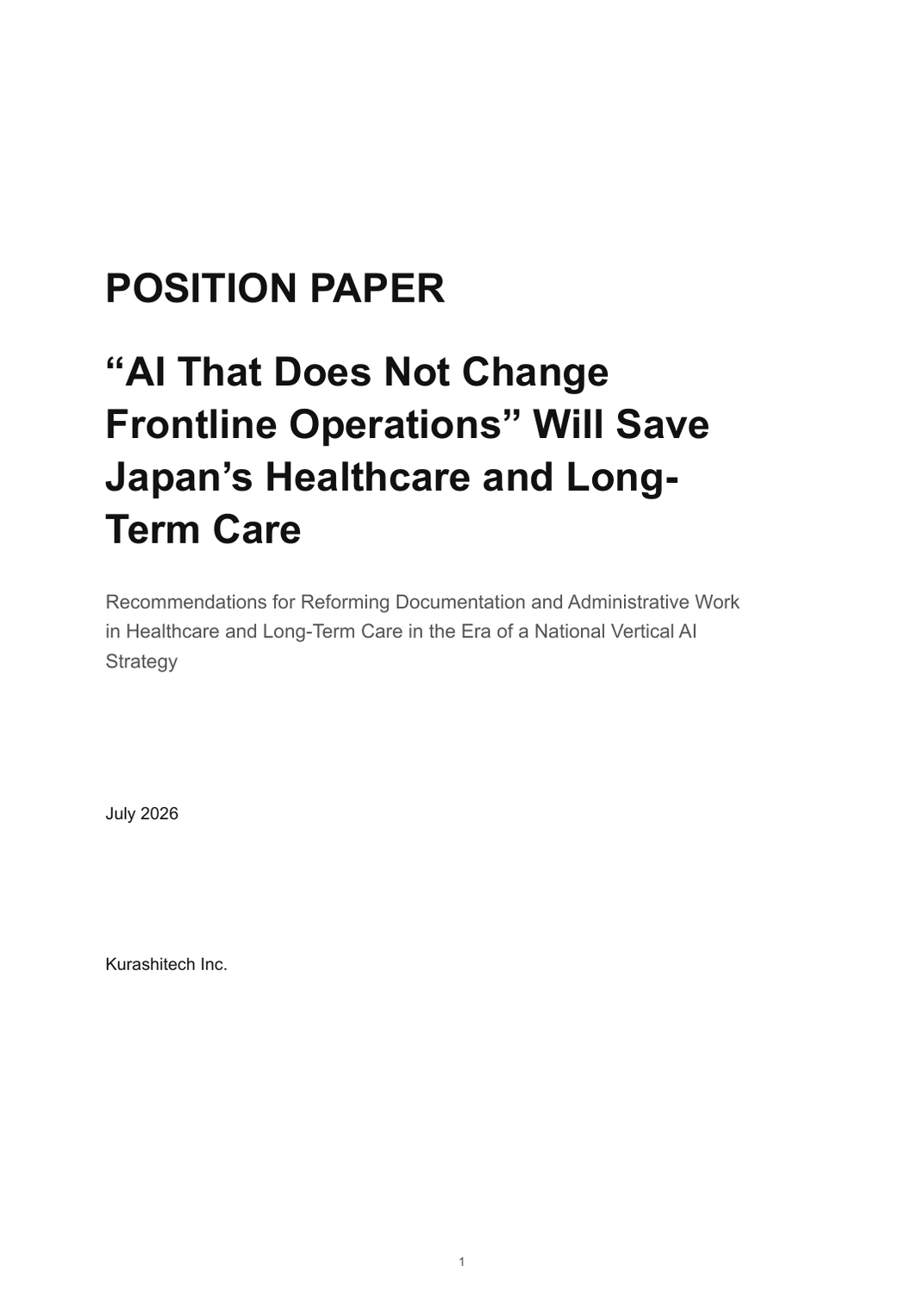
Cover of the position paper

Position Paper

How AI That Preserves Frontline Work Can Save Japan's Healthcare and Long-Term Care

A proposal for reforming medical and care records and administration in the era of Japan's vertical AI strategy

  1. Realities on the front line
  2. A path to solutions through AI
  3. Three proposals to the government